HOA Karen Paved Over My $80,000 Private Road — So I Made All 58 of Their Cars Disappear

The HOA president actually thought she could seize my property just by pouring fresh asphalt over it.
She waited in my driveway with a $12,400 invoice for the “community improvement.”
She was standing right on top of the 400-foot military-grade access road my grandfather built with his own two hands.
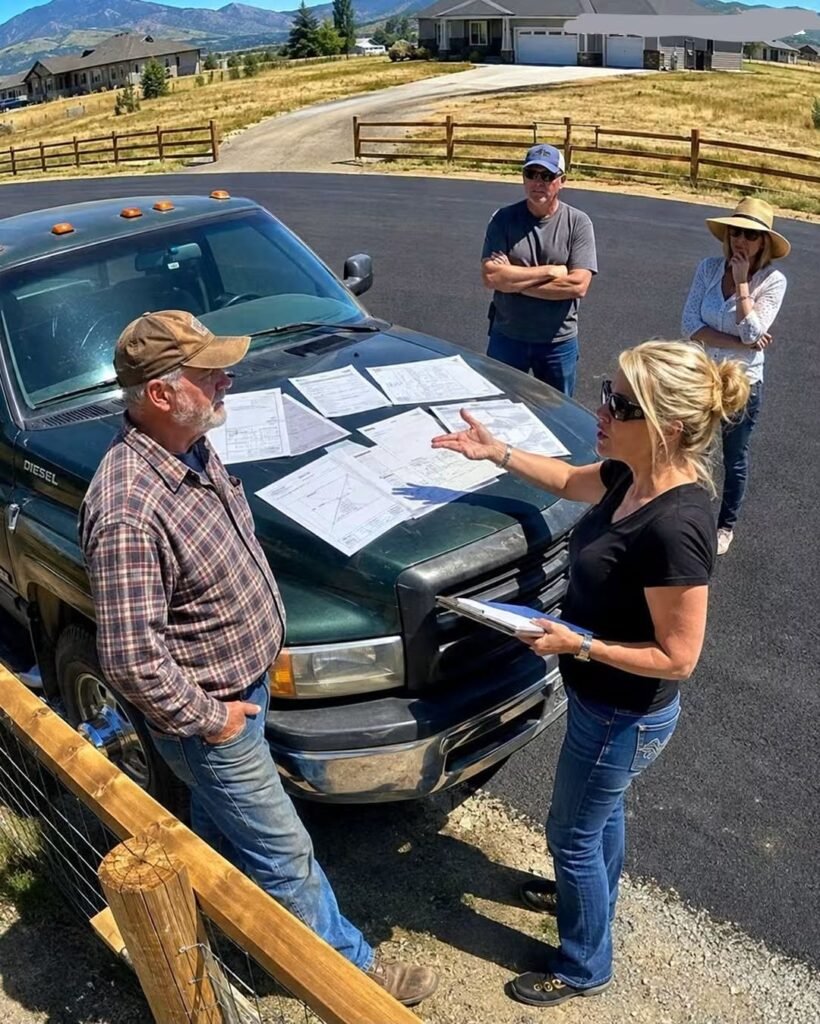
She adjusted her designer sunglasses, tapped her clipboard, and told me her white Escalade had every right to block my property.
That was when I stopped explaining and started documenting.
I already had the 1987 property survey and the county deed sitting on my truck’s dashboard.
I decided to let her dig her own grave.
PART 1
My property sits on three acres of prime Colorado land, completely surrounded by a neighborhood I want absolutely nothing to do with. I inherited the place from my grandfather back in 2010. Along with the house and the barn, he left me the crown jewel that would eventually start a neighborhood war.
It was a 400-foot private access road connecting my acreage to County Highway 34. Grandpa built that road in 1987 with an $80,000 budget and absolute military precision. He engineered it to handle 60-ton vehicles and recorded the deed in granite-solid legal language.
Back then, we were surrounded by cattle pastures and pine forests. The only sounds were the wind through the trees and the occasional rumble of a tractor. It was perfect for a retired Army combat engineer like me who prefers fixing things in silence. But progress always finds a way to ruin a good thing.
In 2019, a developer bought the surrounding ranch land and carved it into 60 identical lots. They birthed Willowbrook Estates, complete with covenant restrictions thicker than a phone book. My property predated their HOA by three decades, so I was legally excluded from their membership.
That arrangement suited me perfectly. I had zero interest in paying three grand a year for the privilege of asking permission to paint my own mailbox. But my exclusion infuriated Vivian Ashworth, the newly elected HOA president. She was a 58-year-old transplant from Phoenix who enjoyed making everyone else’s life miserable.
Within six months of taking power, she showed up at my gate with a clipboard. She pointed her manicured finger at my work trailer and demanded I move it. I explained that I ran a legitimate contracting business and she had zero authority over my land. She just smiled that practiced, icy smile and told me I needed to respect community standards.
Over the next eighteen months, Vivian transformed petty harassment into high art. She cited me for excessive grass height, industrial noise, and leaking fluids on my truck. I ignored every single fake violation. I figured she would eventually get bored and find someone else to torment.
Then I took a week-long contracting job in Wyoming. It was the worst decision I ever made, leaving that woman unsupervised for seven consecutive days. I pulled into my driveway on a Tuesday evening, expecting the familiar crunch of gravel under my tires.
Instead, my diesel truck rolled smoothly over fresh, gleaming black asphalt. The heavy smell of hot petroleum hit me right in the chest. There were yellow speed bumps, crisp white center lines, and brand new HOA property signs staked into my grass.
Vivian’s white Escalade was parked horizontally across the entrance, blocking my access. She stood beside it with her trademark clipboard, waiting with the patience of a spider.
“Congratulations,” she called out, her voice dripping with fake sweetness. “We’ve improved your little dirt path. Your contribution comes to $12,400.”
I shifted my truck into park and stepped out into the evening air. Thirty-seven years of clear ownership, and this woman had the nerve to bill me for paving my own land.
“This is my private road, Vivian,” I said, keeping my voice dangerously level. “You had no right to touch it.”
Her smile widened as she held up a thick folder. “Actually, we have every right. HOA bylaws grant us improvement authority over shared community infrastructure.”
She claimed they were taking ownership through adverse possession because the neighborhood used the road. I knew from my military days that adverse possession requires continuous, exclusive occupation that actually excludes the owner. She had absolutely no idea what she was talking about.
I reached into my center console and pulled out the original 1987 property survey. I spread the documents across my truck’s tailgate like evidence at a crime scene. I pointed to the surveyor’s marks, showing explicitly that lot 47 was my private access easement.
“Your paperwork is outdated,” Vivian countered smoothly, not even looking at the deed. “Modern community standards supersede individual property claims. Our attorney is already reviewing it.”
“Community standards don’t override recorded property deeds,” I told her. “That’s not how America works.”
She pulled out her phone and started typing furiously, announcing an emergency board meeting for the following night. She demanded I attend to explain my refusal to pay for community improvements. Within an hour, she had posted a massive rant on the neighborhood Facebook page calling me a freeloader.
I spent the rest of the evening researching every document related to the HOA’s formation. Three hours of paperwork archaeology revealed something that made my coffee taste bitter. Vivian’s original neighborhood survey had deliberately included my road within the HOA’s proposed boundaries.
Someone had tried to steal my road on paper long before they stole it with asphalt. Around midnight, my phone buzzed with a private message from Janet, the property appraiser three houses down.
“Garrett, you need to know,” Janet wrote. “Vivian came to me last month asking how much paving your road would increase sale prices for HOA properties. This was planned.”
My blood went cold in my veins. This wasn’t neighbor drama anymore. This was organized theft with legal documentation.
That night, I realized Vivian had handed me the perfect weapon to destroy her completely. But first, I needed to call my army buddy who worked for the state transportation department.
Comment ‘ROAD’ below and I’ll share Part 2 in the comments.